
Buying a Property
See our video at the foot of this page.
You, as purchaser, have a responsibility to yourself to do a ‘duty of care’ study of properties in which you are interested. Will there be any caveats on the property, such as easements for power lines, are there declared pests and weeds that you are required to control, does the property have sufficient water storage for your needs and, if not, are there suitable sites for sinking new dams.
This section contains material on bushfire prone areas and local rainfall figures. The Bureau of Meteorology has rainfall data for most centres. When assessing expected rainfall, the best figure to check is the monthly and annual Modal Rainfalls. This is the rainfall that is received most often. It is generally lower than the mean annual rainfall but is more indicative of what you may receive from year to year. Since a step down in annual rainfall in the southern parts of WA was recorded in 1975, the modal rainfall from that date will be more useful than the longer-term figures.
The section also contains a checklist of things to consider in your duty of care study and where you might expect to find answers to your questions.
Lastly, here’s a section on buying a rural property from the DPIRD website:
https://www.agric.wa.gov.au/small-landholders-western-australia/buying-small-property
View our website’s videos on Buying a Property and Planning your New Property.
See the accompanying table on ‘Most important information’ for a property buyer, which contain very useful information for people looking for a rural property.
Most important information when selecting a property – and where you might find answers:
A survey conducted by us during the 2018 Balingup Small Farm Field Day asked people what were the most important pieces of information they required when assessing whether to buy a property. Below are their responses, along with some ideas on where to find the information.
Bushfire Attack Level (BAL) rating *
(Based on State Planning Policy 3.7: Planning in Bushfire Prone Areas, introduced in 2015.)
As part of the bushfire management process, the Department of Fire and Emergency Services (DFES)
provides a mapping system which identifies Bushfire Prone Areas. This acts as a mechanism for
initiating further assessment in the planning and building processes, including preparing a
Bushfire Attack Level (BAL) assessment and a Bushfire Management Plan (BMP). The higher the BAL risk, the more conditions that will be placed on construction and development. Contact your Shire for BAL rating and advice.
The section also contains a checklist of things to consider in your duty of care study and where you might expect to find answers to your questions.
Lastly, here’s a section on buying a rural property from the DPIRD website:
https://www.agric.wa.gov.au/small-landholders-western-australia/buying-small-property
Watch our video on Buying a Property – ‘A fresh new start’ at the bottom of this page.
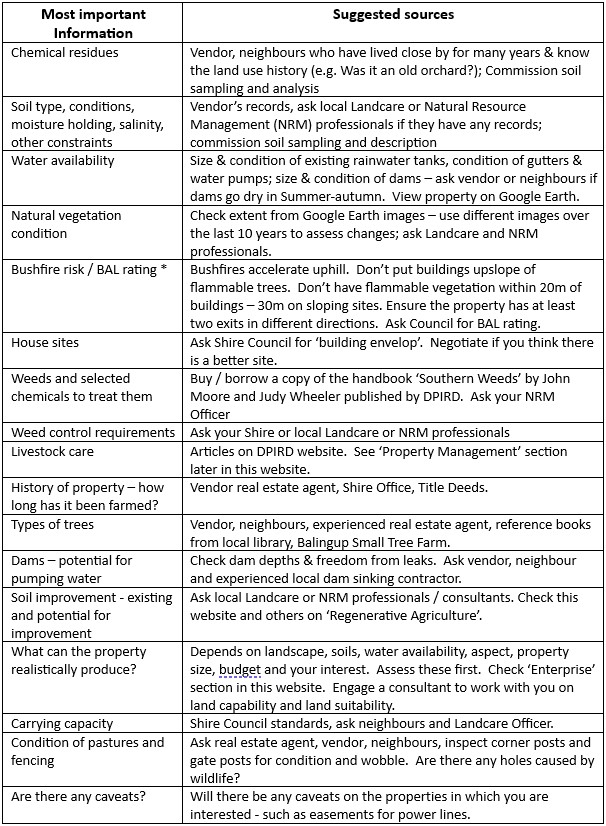
See the accompanying note on ‘Most important information’ for a property buyer and the note on ‘Bushfire prone areas’, which contain very useful information for people looking for a rural property.