
Water Supplies
Water for Rural Properties
Harvesting it, Storing it and Using it efficiently.
Saturday 19 May 2018
Notes taken during a Water Field day by Ian Meyer
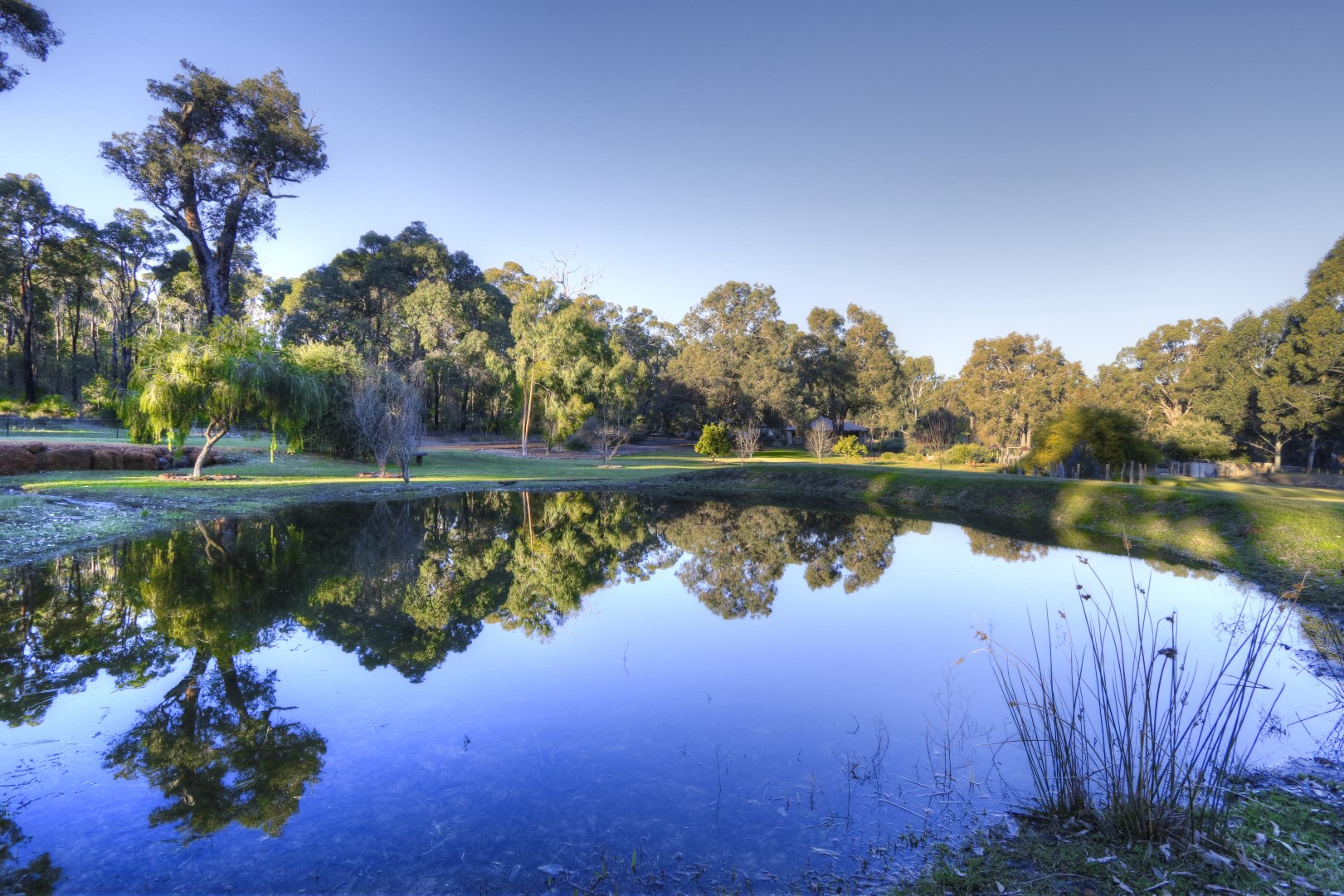
Morning Session – Cook’s Tour of several dam location out Winnejup Rd way.
Presenter: Peter Brown, Dam Designer and Sinker
- Test drilling holes is a great way to confirm a good location, in terms of ground type – clay, how far to rock etc.
- Clay lining of the dam to be waterproof is vital. Smaller dams sometimes might have insufficient clay material to complete this.
- If you do not hit clay within 1000mm of the natural ground level (NGL), it is likely that not enough clay will be un-earthed to seal the dam properly – applies to dams up to 300 to 400 cubic yards.
- A dam of 2000 cubic yards would cost around $3,500 in today’s prices.
- 1 in 3 slope on the inside wall of the dam is the industry standard. Minimises issues later and is the ‘natural slope’ which over time the wall gets to.
- Optimum slope of the land for a dam is 5%. Good wall construction allows for a water level retention of between 500 and 1000mm above the NGL.
- Free board is the dam wall height above the intended dam capacity. It should be between 1000 and 2000mm above the intended capacity point.
- In the photos is a 2000 cubic yard dam. Using road drainage as its main water source. Includes a silttrap, immediately uphill to extend the life of main dam. The pipe between the silt trap and dam has a downturned elbow at the silt trap end. This keeps silt and organic matter from getting into the dam, thus reducing the frequency that silt needs to be removed from the dam, and reducing the possibility of having an algal bloom.
- Past practices mean that salt can be an issue in gullies. To overcome this the dam design can include a mechanism to overcome this, as salty water sinks. Use a pipe with an end close to the bottom (not at the bottom otherwise silting can become an issue) which can draw the saline bottom water out – either through a pipe through the dam wall installed during construction or syphoned over the wall of the dam in a poly pipe.
- Dams can need permits, so consult your local Shire and/or Department of Water. The Department will advertise if necessary.
- Soaks and Gully dams on unnamed drainage lines generally do not need permits. If a creek is named, it is likely to need some sort of permit for a dam to be constructed. Hillside dams (‘Three siders’) are less likely to need permits since they interfere far less with environmental flows down creek lines.
- Sometimes it might be a couple of years before a dam holds water, as the final compaction is achieved. “Sheep foot compaction” is a technique used by farmers. Sheep do a great job at achieving compaction. Cows do not – they tend to be more destructive than supportive. Wind is a major cause of water evaporation. An island in the dam will assist in “breaking” the wind action. Anything to stop wave action and evaporation is important.
- Trees too close to a dam are not good as their roots can break the seal. Once they die the impact can be even worse.